Advocacy > Local initiatives > Lincoln Climate Action Plan

Page 7 of the Lincoln Climate Action Plan – Lincoln’s climate risks
History and details
Mayor Leirion Gaylor-Baird’s 2021-2027 Climate Action Plan was passed by the Lincoln City Council in March of 2021. The plan both describes Lincoln’s primary risks from climate impacts, along with outlining various ambitious goals for the city to achieve in the coming years.
The plan has eight “action areas,” through which 118 more particular goals are sorted. Each individual goal is either labeled with a “C” (for when the city is simply Continuing a current effort), or an “N” (for when the city will be taking on a New effort). Goals that are contingent on further funding, regulations, or another form of City Council approval are also highlighted a light blue.
Various aspects of the plan are highlighted below (all quotes and images courtesy of the Climate Action Plan); a full PDF of the final Lincoln Climate Action Plan is available at the bottom of this page.
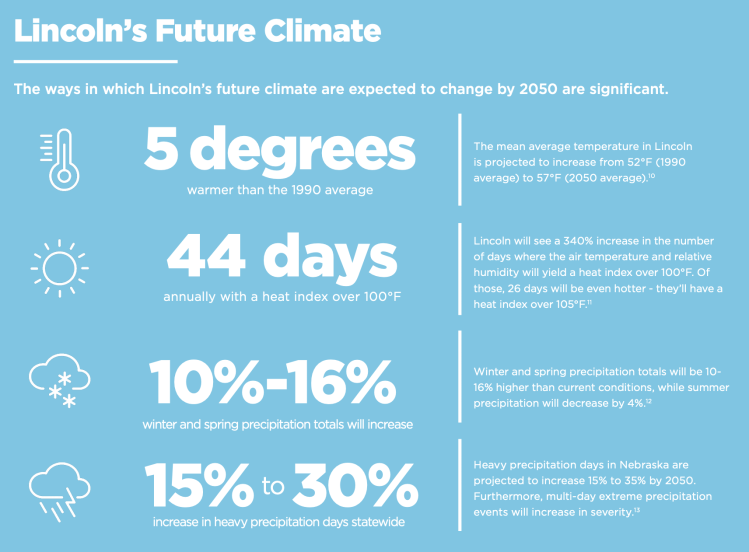
Lincoln’s climate risks
“The planning process identified 12 main areas where the city is exposed to risk in the ways that climate impacts may intersect with existing social and infrastructure vulnerabilities.
- Flooding
- Drought
- Single water source
- Public health risks
- Disproportionate impact on vulnerable populations
- Financial and workforce resources not aligned with climate risks and opportunities
- City policies not aligned with climate risks and opportunities
- Auto-reliant transportation system
- Reliance on fossil fuels
- External control over food supplies
- Vulnerable natural resources
- Public awareness”
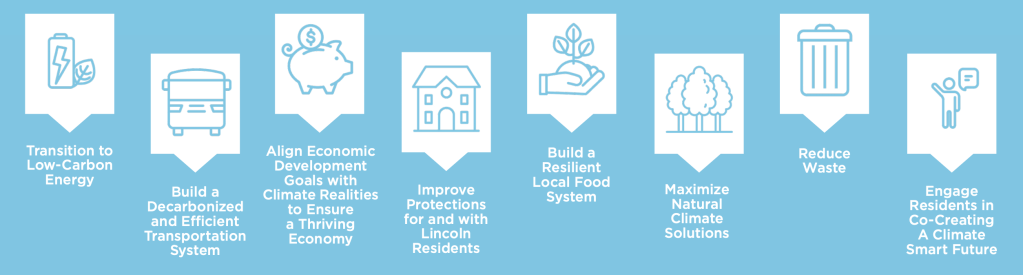
Action areas
Based on the above climate risks, the city identified 8 primary action areas for climate goals and policies:
Other initiatives
From there on, the city outlines 118 goals (or initiatives) for the city to achieve in the next 6 years; each of the goals also helps contribute towards Lincoln’s greater goal of reducing emissions by 80% by the year 2050 (relative to 2011 levels). To see these initiatives (and more information on the above), scroll through the PDF or download it here:
 SustainLNK