Reworking your waste stream > Managing your waste stream > Recycling in Lincoln > Where does Lincoln’s recycling go?
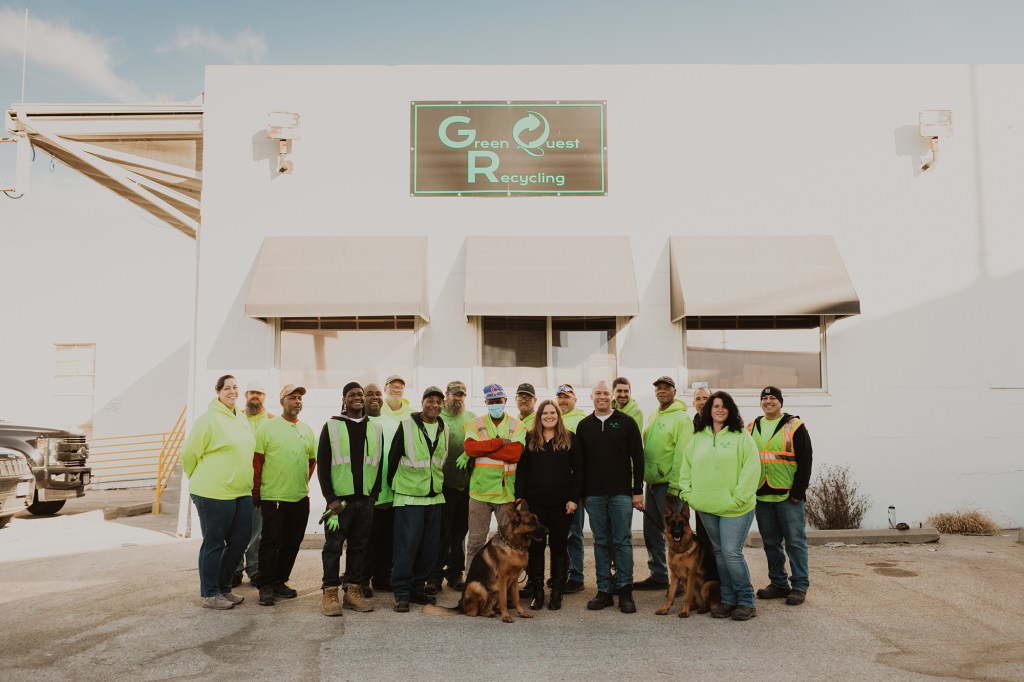
Team at Green Quest Recycling
Image courtesy greenquestrecycling.com
Lincoln’s recycling
Lincoln’s two Material Recovery Facilities (MRF’s)
After recycling is dropped off at a public site or picked up by a private waste hauler, it is then brought to one of Lincoln’s two partnered MRF’s – First Star Recycling and Green Quest. These MRF’s sort the recycling and plan the recycling process, partnering with processing plants around North America and internationally.
Because these MRF’s are private companies, they aren’t required to disclose what they do with the recycling once they receive it. However, Green Quest makes public the majority of the partnerships they have with their processing plants, meaning that you can see exactly where your materials may end up at the link below.
While you can’t know for sure which MRF your recycling will end up at, it can still be interesting to learn a little more about the process!
What about plastic film?
Plastic film can damage and break the machines used to sort recycling in the MRF’s – in turn, it is collected in separate locations, oftentimes grocery stores. Some stores in Lincoln, such as Hy-Vee and Bakers, have a partnership with Trex Lumber. Trex Lumber melts the plastic film and mixes it with sawdust to create their composite lumber.
Can we guarantee the material is recycled?
Many of us have heard horror stories of recyclable materials being shipped across the ocean to other counties, only to be left in a mass or burned – contaminating that country’s environment. Oftentimes, this causes people to doubt the trustworthiness of our recycling process.
According to Willa DiCostanzo, Waste Diversion Coordinator for the City of Lincoln, the primary reason why recyclables end up thrown away or abandoned in another country is because of high contamination rates. Not properly cleaning and sorting materials makes the recycling process very timely and expensive for companies, which oftentimes costs more money than they make from the process. In turn, outside of simply cutting back on single-use materials, the best method to ensure your materials are recycled is to ensure that they are labeled as recyclable, properly cleaned, and properly sorted (unless collected through a single-stream collector).
 SustainLNK